
Ready to get started?
Easily integrate next-generation payments and financial data into any app. Build powerful products your customers love.
SHARE ARTICLE


 Share link copied!
A customer has 30 days to pay the invoice, but it remains outstanding after six weeks. Then the finance team discovers it was sent to the wrong department. By the time the customer processes it, another payment cycle has passed. If it happens with several customers, these delays can leave a significant amount of money tied up in unpaid invoices.
A credit control process helps businesses avoid this by setting clear rules for customer credit, invoicing, payment collection and overdue accounts. For finance teams managing multiple locations, it also establishes who is responsible for each stage and when action is required.
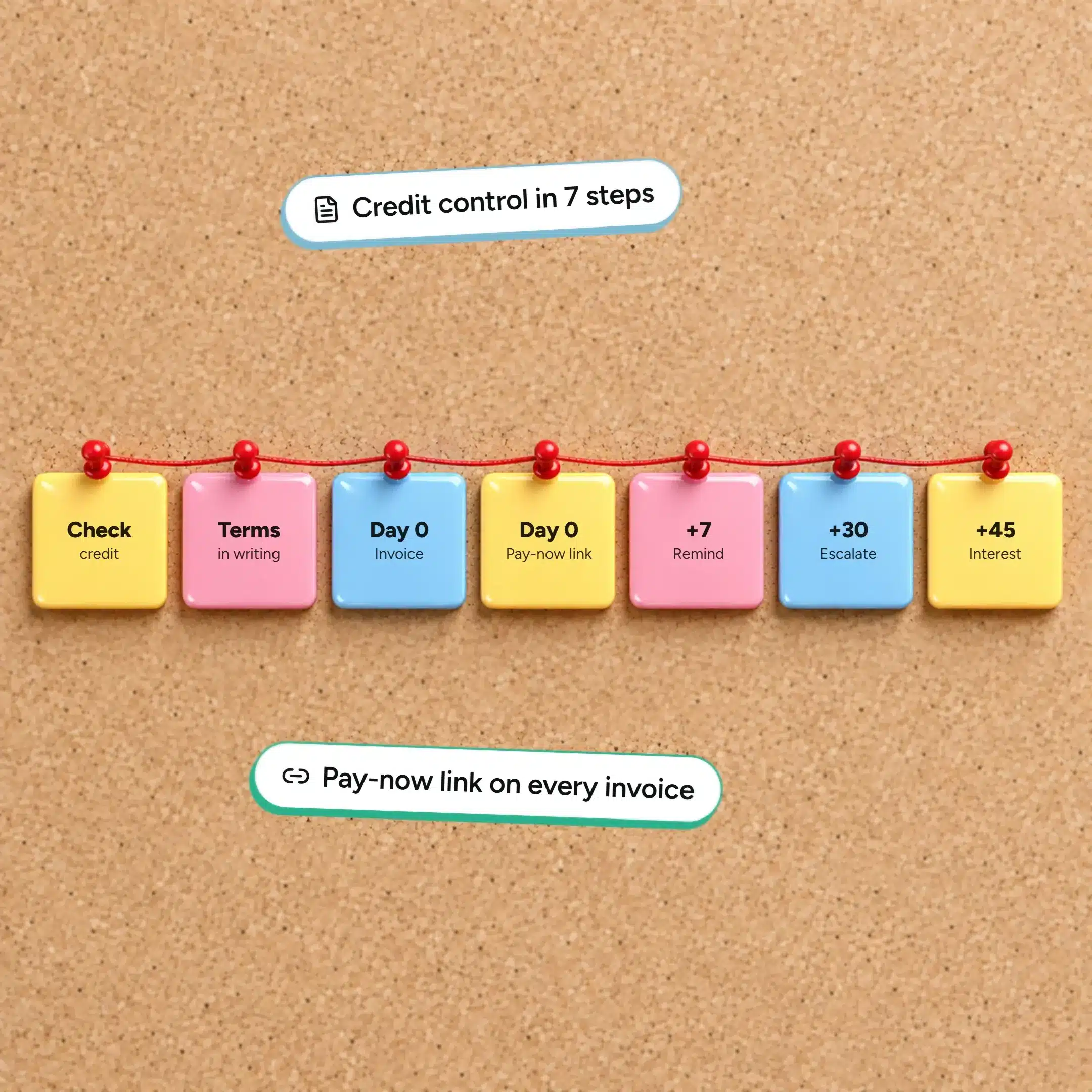
A credit control process is the procedure that a business follows to decide who gets credit, on what terms, and how unpaid invoices are followed up. A good credit control process covers seven steps: credit checks, written terms, accurate invoicing, easy ways to pay, a fixed reminder schedule, staged escalation and regular measurement using days sales outstanding (DSO). The aim is to get paid on time without damaging customer relationships.
What Is Credit Control?
Credit control is the process of assessing customer creditworthiness, setting payment terms and collecting money owed within those terms. It forms part of accounts receivable management and helps businesses limit bad debts while maintaining sufficient cash flow.
The process begins before a customer receives credit and continues until the invoice is paid or the debt is otherwise resolved. A well-managed credit control function also helps businesses identify customers who repeatedly pay late, review their credit exposure and make informed decisions about extending further credit.
How to Measure Credit Control Days Sales Outstanding (DSO)
Days sales outstanding (DSO) is the average number of days it takes a business to collect payment after a credit sale. It’s the single most useful number for judging whether your credit control process is working.
DSO = (trade receivables ÷ credit sales in the period) × days in the period
For example, a multi-site business makes £900,000 of credit sales in a 91-day quarter and has £540,000 in unpaid invoices at quarter end.
- DSO = (£540,000 ÷ £900,000) × 91 = 54.6 days
- Average credit sales per day = £900,000 ÷ 91 ≈ £9,890
- Cutting DSO by 10 days would release roughly £98,900 of cash that’s currently sitting with customers.
Compare your DSO with your standard terms. If you invoice on 30 days and DSO is 55, customers are paying, on average, more than three weeks late. Track it monthly, alongside an aged debt report (current, 1–30, 31–60, 61–90 and 90+ days overdue), so you can see whether the problem is a few large debtors or a general drift.
Credit Control Process: 7 Essential Steps
These are the credit control process steps, with the day each one starts, who owns it and what it should produce. Day 0 is the invoice date. A documented process prevents credit decisions and payment follow-ups from depending on individual employees. It should specify what happens at each stage, who handles it and when an issue needs escalating.
1. Assess Customer Creditworthiness
Before offering credit, review the customer’s financial position and payment history. Business credit reports can identify financial risks, including County Court Judgments (CCJs), while trade references and previous transactions provide further context.
The level of assessment should reflect the potential exposure. A customer requesting a £50,000 credit facility warrants closer examination than one placing occasional small orders.
Credit checks should also be repeated when circumstances change, such as when a customer regularly misses payment deadlines or requests a substantial increase in their credit limit.
2. Agree Payment Terms and Credit Limits
Payment terms should be agreed before goods are supplied or work begins. Businesses commonly use 14-day or 30-day terms, although the appropriate period depends on the customer relationship and commercial agreement.
The credit policy should establish the maximum outstanding balance permitted, who can approve exceptions and when additional orders require review.
For example, if a customer has a £20,000 credit limit and already owes £18,000, a further £5,000 order would exceed the agreed exposure. Finance approval should be required before extending additional credit.
Across multiple branches, limits should be monitored against the relevant customer account or legal entity rather than treating every location’s orders independently.
3. Issue Accurate Invoices Promptly
Late invoicing delays the payment process, while incorrect details can stop an invoice from being approved altogether.
Raise invoices when the agreed billing event occurs and check that they contain the information the customer requires:
- Correct legal entity and billing details
- Invoice number, date and payment deadline
- Purchase order number, where required
- Agreed charges and applicable VAT
- Clear payment instructions
Confirm the correct accounts payable contact before submitting an invoice. Larger customers may also require invoices through a supplier portal or within a particular billing window.
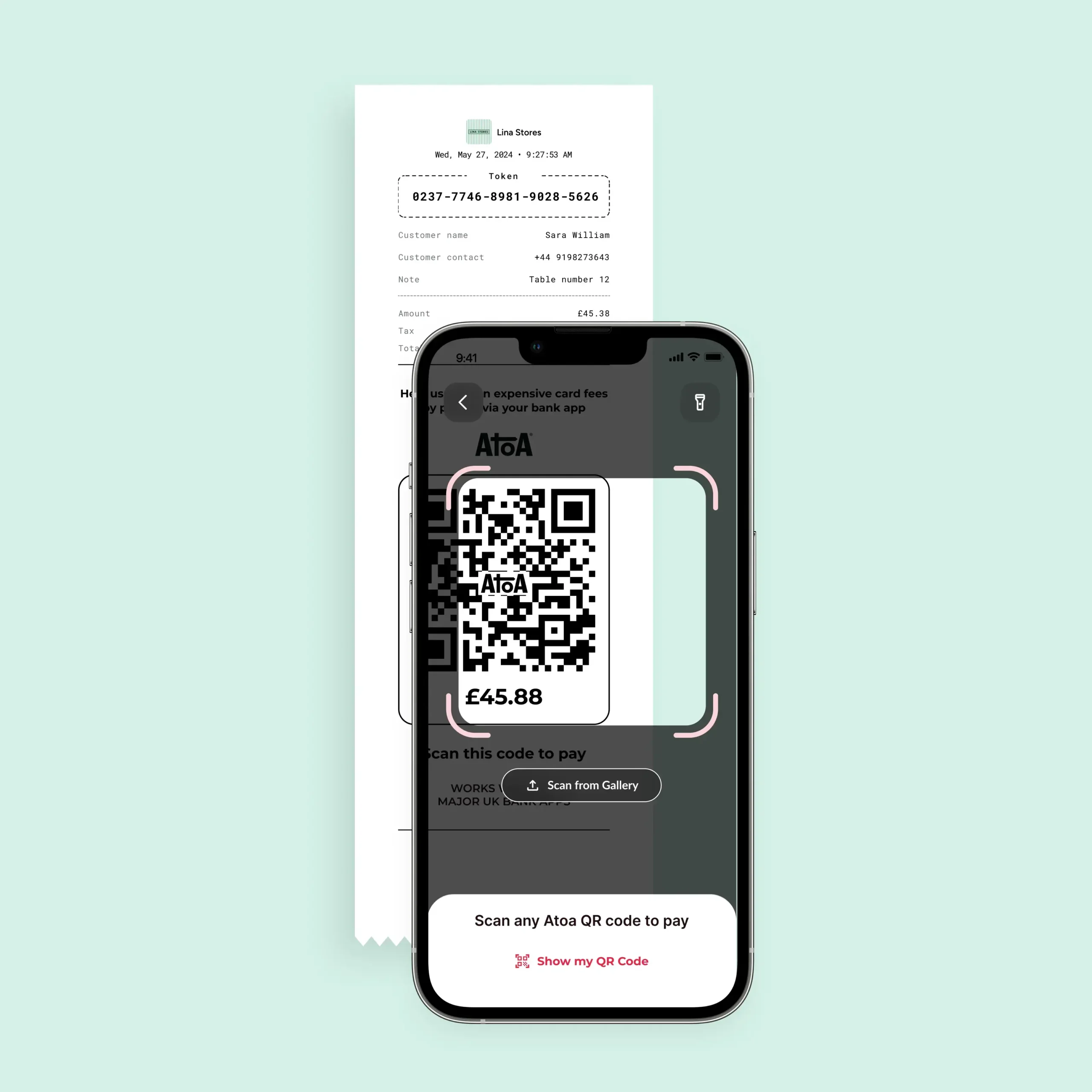
Payment instructions should be equally straightforward. For example, Atoa’s invoice payments allow customers to settle invoices through a payment link rather than manually entering bank details.
Whichever method is used, payments should be matched promptly against the correct invoice to keep outstanding balances accurate.
4. Monitor Outstanding Balances
An aged receivables report shows how much customers owe and how long invoices have remained unpaid.
Most finance teams group balances into current, 1–30 days overdue, 31–60 days overdue, 61–90 days overdue and over 90 days overdue.
Reviewing these figures weekly helps identify overdue accounts before balances accumulate.
Collection priorities should consider both the age and value of an invoice, together with the customer’s payment history.
A £15,000 invoice that is five days overdue may require more immediate attention than a £200 invoice overdue for two weeks.
For multi-site businesses, a consolidated receivables report also prevents separate branches from overlooking the total amount owed by the same customer.
5. Follow a Consistent Reminder Schedule
Payment reminders are more effective when they follow an agreed timetable rather than being sent whenever someone has time.
For invoices with 30-day payment terms, finance teams could use the following schedule:
| Timing | Action |
|---|---|
| 5 days before the due date | Send a polite reminder |
| 1 day overdue | Confirm the outstanding amount |
| 7 days overdue | Contact the customer and request a payment date |
| 14 days overdue | Escalate to the accounts payable manager |
| 21–30 days overdue | Review credit restrictions or formal recovery |
This is an example but not a statutory timetable. The appropriate intervals depend on customer risk and the agreement.
Record each response, particularly promised payment dates and unresolved disputes. If a customer commits to paying on Friday, the next action should depend on whether that payment arrives.
Automated reminders can handle routine follow-ups, but disputed invoices and repeated missed commitments require individual attention.
6. Escalate Overdue Accounts
When repeated reminders fail, establish whether the problem is an invoice dispute, an administrative delay or the customer’s ability to pay.
Disputed charges should be investigated with the relevant sales or operations team. If only part of an invoice is disputed, consider requesting payment of the undisputed amount.
Where a customer faces temporary financial difficulties, a written instalment plan may be appropriate. It should specify payment amounts, due dates and what happens if an instalment is missed.
Persistent non-payment may require restricting further credit, placing orders on hold or beginning formal recovery.
These decisions should follow the contract and an agreed approval process. Account managers should not independently extend further credit to customers whose balances have already exceeded approved limits.
7. Review Credit Control Performance
Collection activity should be assessed through measurable results rather than the number of reminders sent.
Useful indicators include:
- Days sales outstanding (DSO): The approximate number of days of credit sales tied up in receivables.
- Overdue debt percentage: The proportion of outstanding receivables past their due dates.
- Payment performance: The percentage of invoices settled within agreed terms.
- Disputed invoice value: Money awaiting resolution rather than payment.
- Bad debt write-offs: Amounts considered uncollectable and written off.
Reviewing these measures by business location or customer group can reveal problems that company-wide figures conceal. For example, a branch with consistently high overdue balances may have an invoicing problem rather than customers with poor payment histories.
How to Reduce DSO
Reducing DSO requires identifying where time is being lost between billing and collection.
If customers regularly reject invoices because purchase order numbers are missing, sending reminders earlier will achieve little. Fixing the invoicing process is likely to be more effective.
Finance teams should concentrate on four areas:
- Billing delays: Issue invoices promptly and prevent avoidable approval problems.
- Credit terms: Review customers whose agreed terms exceed what the business can comfortably finance.
- Collection priorities: Focus on high-value overdue accounts and repeated late payers.
- Payment reconciliation: Allocate incoming payments quickly so the receivables report reflects what is actually outstanding.
What Does a 12-Day Reduction in DSO Mean?
Consider a business generating £2.4 million in annual credit sales.
Reducing DSO from 52 to 40 days would lower the amount tied up in trade receivables by approximately:
£2,400,000 × (12 ÷ 365) = £78,904
| Measure | Before | After |
|---|---|---|
| Annual credit sales | £2,400,000 | £2,400,000 |
| DSO | 52 days | 40 days |
| Approximate receivables | £341,918 | £263,014 |
| Reduction in receivables | — | £78,904 |
Illustrative calculation assuming stable credit sales, with figures rounded to the nearest pound.
The £78,904 represents working capital no longer tied up in receivables. It is not additional revenue or profit, but that cash may become available for supplier payments, stock purchases or other operating expenses.
When Should a Business Consider Invoice Factoring?
Invoice factoring may be appropriate when a business has reliable customers but needs access to funds before their invoices become due.
Under a factoring arrangement, a finance provider advances a proportion of the value of eligible unpaid invoices and typically manages the associated collections.
For example, a wholesaler waiting 60 days for payment might use factoring to access working capital needed for additional stock purchases.
However, factoring involves fees and may change how customers interact with the business.
Invoice discounting offers another arrangement in which the business generally continues managing its own collections.
The choice depends on funding requirements, invoice volumes, costs and whether the business wants to retain control of its sales ledger.
Factoring should not be treated as a substitute for proper credit checks or a way to recover debts unlikely to be paid.
What Changes When Invoices Carry a Pay by Bank Link
With Atoa, the pay-now link on the invoice opens a payment page where the customer pays from their own Bank app, with the amount and reference filled in, or by card where you enable it. The payment is confirmed in seconds and paid out instantly or on the next working day, depending on your settlement setup. The dashboard shows each invoice as sent, partially paid, paid or overdue, and where you accept partial payments, a customer can pay part now and the rest later through the same link. Payments reconcile with Xero, QuickBooks and Sage; for Xero users, see Xero invoice payments.
There are no chargebacks on Pay by Bank, though your own refund policy still applies and refunds are made from the dashboard. Each payment can be up to £15,000, with higher limits on request. Pay by Bank costs 0.7% + 20p per payment, ex VAT, as set out in our published rates. Atoa is authorised by the FCA (FRN 1007647). Terms, credit decisions and recovery stay with your finance team; Atoa takes the payment. To see how it fits your ledger, book a demo with our team.
Frequently Asked Questions
What is a credit control process?
A credit control process is the routine a finance team uses to decide which customers get credit, on what terms, and to collect what they owe on time. It runs from credit checks and written terms before the first order, through same-day invoicing and fixed reminders, to account holds, statutory interest and recovery when payment does not arrive.
What are the steps in the credit control process?
There are seven steps, each with a trigger: check credit and set a limit before the first order; put terms in writing on the quote; invoice correctly on Day 0; add a pay-now link on Day 0; remind before the due date, on it and at 7, 14 and 30 days overdue; escalate and hold at 30 to 45 days; then claim interest, recover or finance.
How can a finance team reduce DSO?
Invoice on the day of delivery, put a pay-now link on every invoice, chase on a fixed cadence rather than when there is time, and agree an account-hold trigger in advance. Each day cut releases one day of credit sales: on a ledger with £2.4 million of annual credit sales, that is £6,575 a day, or £78,904 for a 12-day cut.
What should a credit control policy include?
Scope and an owner; roles; new-account checks, credit limits and approval levels; standard terms and who approves exceptions; invoicing standards; the reminder cadence; the dispute window and owner; account-hold triggers; when statutory interest is claimed and who can waive it; bad-debt provision and write-off authority; external recovery and invoice finance; KPIs such as DSO; and a review date.
When should a business consider factoring or invoice finance?
Treat it as a funding decision, set in your credit control policy in advance, not a last resort for one bad debt. With factoring, the provider advances most of the invoice value and also manages the sales ledger and collects from customers; with invoice discounting, you borrow against invoices and keep collecting yourself. Atoa does not provide finance or collections.
Sources
- GOV.UK – Late Commercial Payments: Interest and Debt Recovery – Payment deadlines, statutory interest and recovery costs.
- Late Payment of Commercial Debts (Interest) Act 1998 – UK legislation governing qualifying late commercial payments.
- GOV.UK – Check When Businesses Pay Invoices – Published payment practices of qualifying large companies and LLPs.
- British Business Bank – Invoice Finance – Invoice factoring, discounting, eligibility and costs.
SHARE ARTICLE
Share link copied!