
Ready to get started?
Easily integrate next-generation payments and financial data into any app. Build powerful products your customers love.
SHARE ARTICLE


 Share link copied!
Cash might account for only a handful of sales at the till, but someone still needs to count it, manage the change and deposit the takings. Even a small amount creates work after the shop closes.
With cash payments declining across the UK, businesses are reconsidering how they accept money. Some have stopped taking cash, while others are keeping it alongside cards and in-person payments through Pay by Bank. The decision comes down to handling costs, transaction fees and how customers prefer to pay.
How Much Cash Is Still Used in the UK
Cash accounted for 8% of all UK payments in 2025, according to UK Finance’s UK Payment Markets 2026 report. That represents 3.9 billion transactions, down from 4.3 billion in 2024, when cash made up 9% of payments.
The decline is more striking over a decade. Cash accounted for 45% of UK payments in 2015. UK Finance forecasts that its share will fall to around 4%, or two billion payments, by 2035.
However, these figures cover payments across the economy, not just purchases at shop tills.
The British Retail Consortium (BRC) found that cash still accounted for 19.2% of retail transactions in 2024. Meanwhile, UK Finance estimates that 1.4 million adults mainly use cash for everyday spending.
Cash use is falling, but it remains important to enough customers that businesses should examine their own sales before removing it.
What Are the Cash Handling Costs for Businesses?
Cash doesn’t attract a card-processing fee on each sale, but accepting it still costs money.
The BRC’s 2024 Payments Survey found cash was cheaper to process than other payment methods for participating large retailers. Smaller businesses may have a different experience because their cash volumes are lower.
The main cash handling costs include staff time spent counting and reconciling tills, bank deposit charges, trips to deposit takings, cash collection, insurance and losses from errors or theft.
Consider a shop that spends ten minutes cashing up each day. Over 26 trading days, at an illustrative staff cost of £15 an hour, that’s £65 a month spent handling cash before banking charges or other expenses.
That doesn’t automatically mean the business would save £65 by going cashless. The time may simply move to other tasks without reducing payroll costs.
To understand the actual expense, add up a month’s cash-related costs and divide the total by the number of cash payments received. Then identify which costs would genuinely disappear if cash volumes fell.
What Would Replacing Cash With Digital Payments Cost?
Going cashless removes some handling work but introduces payment-processing fees.
Take a café receiving 1,200 cash payments a month, averaging £8 each. That’s £9,600 in monthly sales.
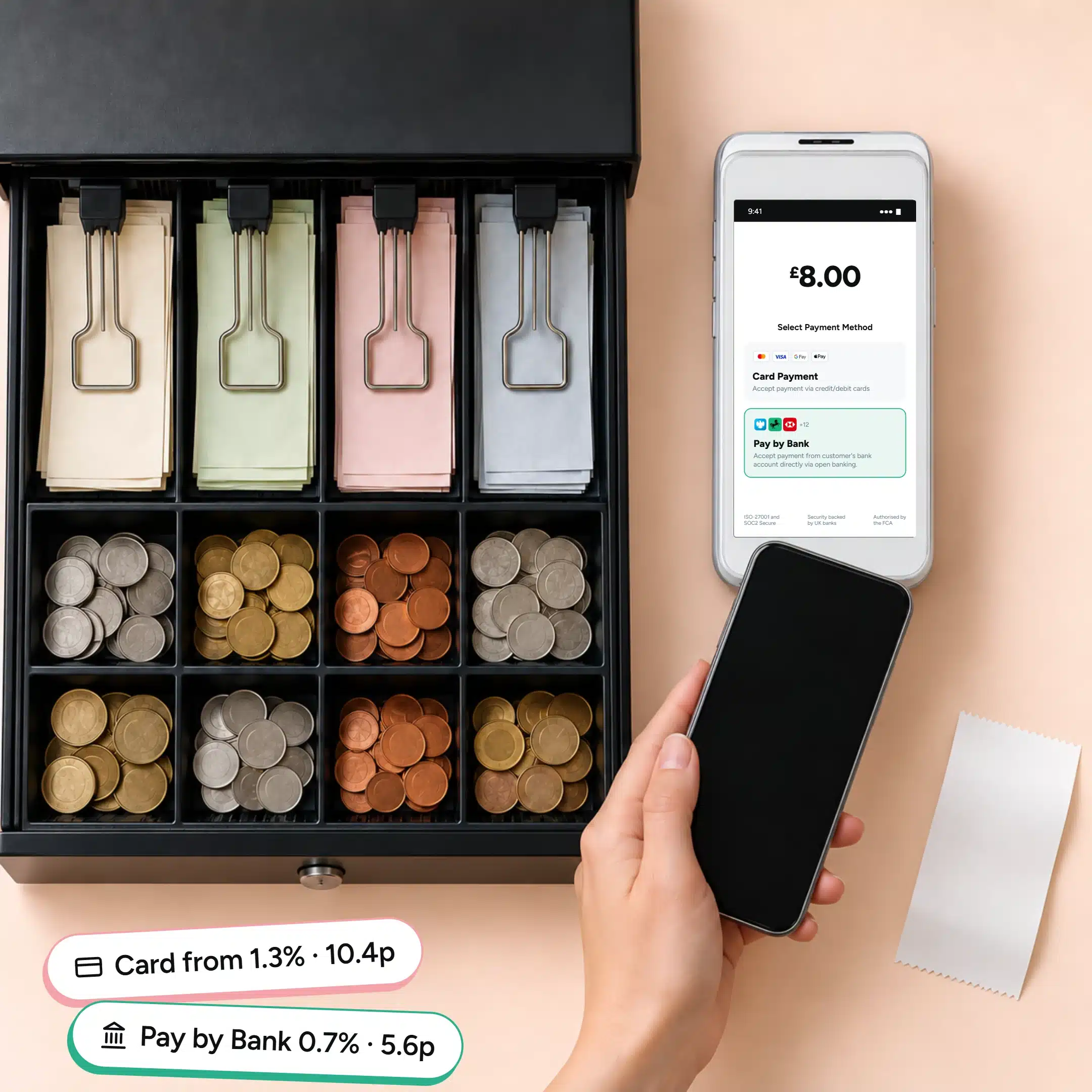
Here’s what processing those payments digitally would cost at Atoa’s published starting rates for in-person transactions.
| Payment method | Per payment | Monthly cost | Annual cost |
|---|---|---|---|
| Card at 1.3% | 10.4p | £124.80 | £1,497.60 |
| Pay by Bank at 0.7%, no fixed fee | 5.6p | £67.20 | £806.40 |
| Difference | 4.8p | £57.60 | £691.20 |
Illustrative figures excluding VAT, terminal costs and any applicable additional charges. Card rates vary by card type and business.
Pay by Bank would cost £691.20 less annually than cards in this example, assuming all 1,200 payments used one method or the other.
That’s a comparison between digital payment fees, though, not a guaranteed saving from replacing cash. A business must weigh those fees against the cash-handling costs it can actually avoid.
Fixed fees also matter on small purchases. A 20p transaction charge adds 2.5% to an £8 payment before any percentage fee.
Do Shops Have to Accept Cash in the UK?
No, UK businesses can choose which payment methods they accept. The Bank of England explains that legal tender has a narrow meaning relating to the settlement of debts. It doesn’t require a shop to accept banknotes or coins for an ordinary purchase. However, refusing cash can create accessibility issues.
In Great Britain, the Equality Act 2010 requires service providers to consider reasonable adjustments for disabled customers. If a cashless policy places disabled customers at a substantial disadvantage, adjustments may be necessary. Separate disability discrimination rules apply in Northern Ireland.
There is also the risk of losing sales. Bank of England research cited in the Government’s July 2025 response to the Treasury Committee found that, among consumers who encountered a cash-free store, 8% had to shop elsewhere and 6% did not buy the item they wanted.
The FCA’s access-to-cash rules, introduced in September 2024, are separate. They require designated banks and building societies to address significant gaps in cash access, but they do not require retailers to accept cash.
Cash, Card, or Pay by Bank: Which is Better?
A cashless business avoids counting notes, preparing floats and making cash deposits. Card payments, however, come with processing fees and potential chargebacks. Businesses also depend on electronic payment systems availabitliy throughout. .
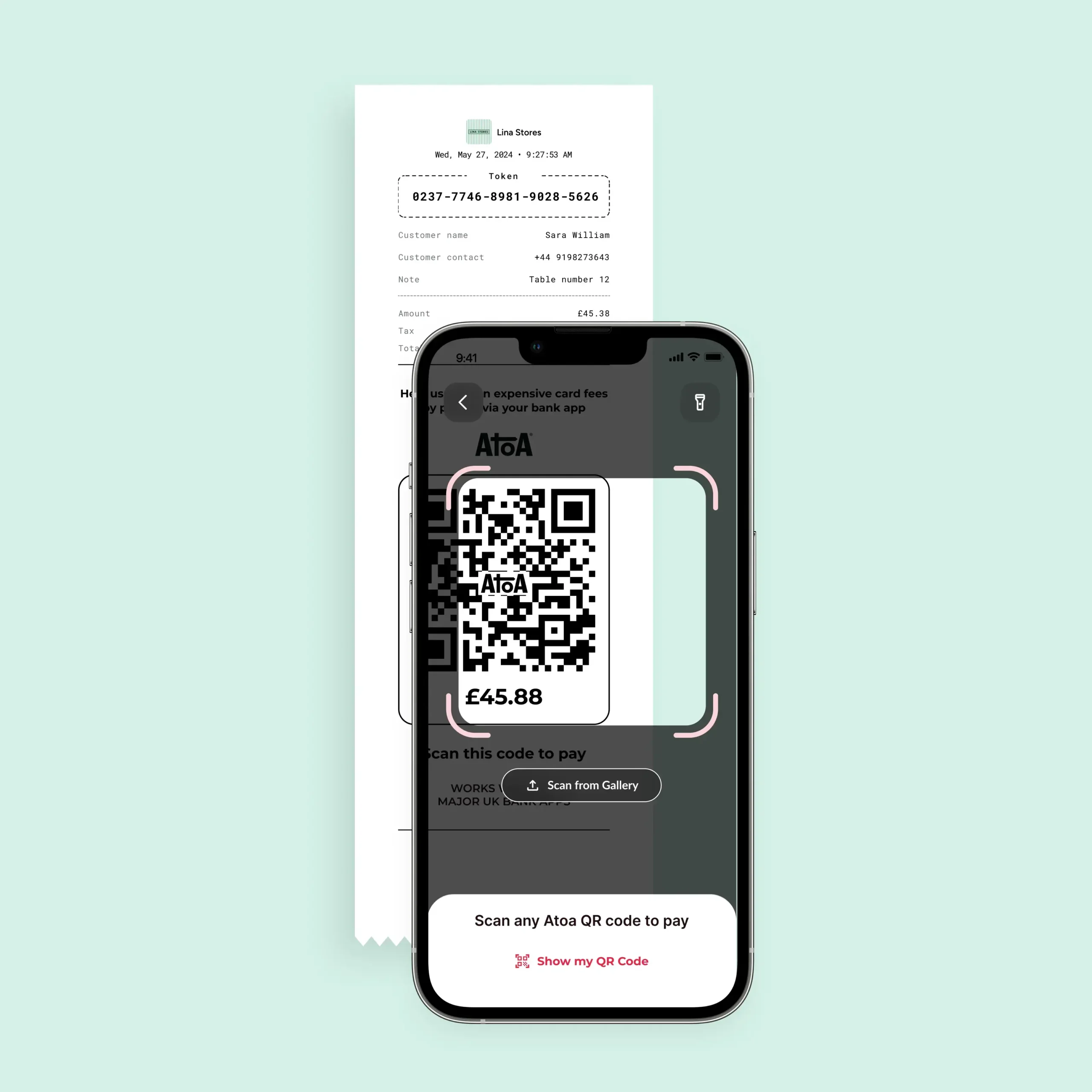
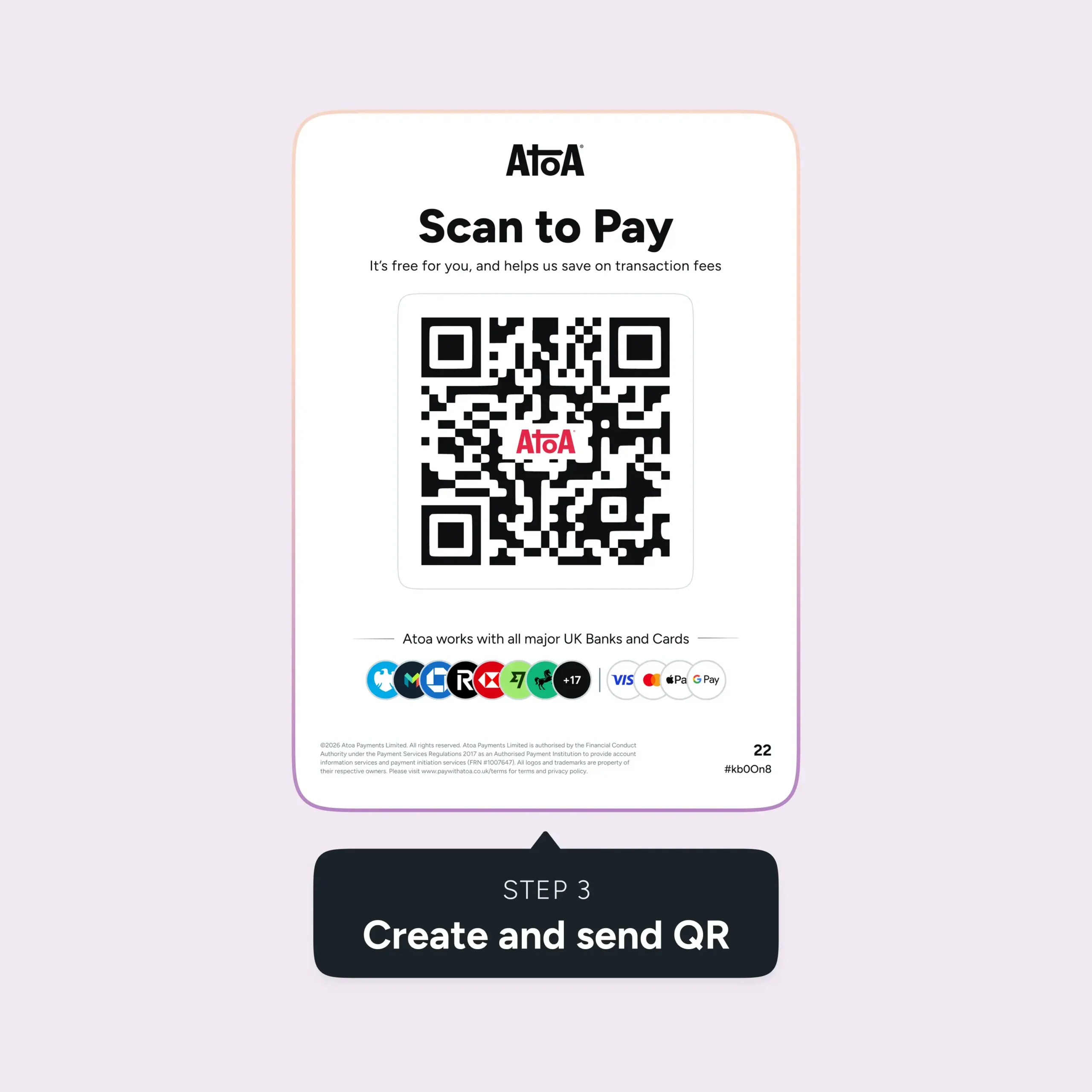
Keeping cash alongside cards gives customers more choice but the handling work remains. This is where Pay by Bank provides another option. At the till, a customer scans a QR code, selects their bank and approves the payment in their banking app.
Atoa supports this through QR codes or a terminal that also accepts contactless and chip-and-PIN payments. Pay by Bank payments can be confirmed within seconds, with instant settlement for most small businesses and next-working-day payouts for larger businesses, depending on the arrangement.
Unlike card transactions, Pay by Bank payments aren’t subject to card-scheme chargebacks, although refunds and payment disputes can still arise. Customers need access to a supported banking app.
Businesses can also reduce cash handling without refusing cash altogether. Taking fewer cash payments may mean less time cashing up and fewer bank deposits while preserving an option for customers who rely on it.
Before changing a payment policy, review a month’s transaction records, calculate the costs of handling cash and compare them with digital payment fees. The broader benefits of cashless transactions are worth considering, but reducing cash dependence may be more practical than removing it completely. and Atoa works with EPOS systems including Tevalis, pointOne and TillTech. In-person Pay by Bank costs 0.7% per payment with no fixed fee, ex VAT.
Frequently Asked Questions
Do shops have to accept cash in the UK?
No. Legal tender is about settling debts, not shop sales, so a business can choose which payments it accepts, and the Government has no plans to compel cash acceptance. The Equality Act 2010 does not specifically require cash, but if refusing it puts disabled customers at a substantial disadvantage, a business may need to consider reasonable adjustments.
Is the UK becoming a cashless society?
Not entirely. Cash fell to 8% of UK payments in 2025, and UK Finance forecasts about 4% by 2035, but it says the decline has slowed as cash use concentrates among people who strongly prefer it. About 1.4 million adults still mainly use cash for day-to-day spending.
How much does it cost a business to handle cash?
For large retailers, the BRC found cash cost 0.20% of sales to process in 2023, up from 0.15% in 2022. For a single site, the bigger costs are staff time cashing up, bank deposit charges and trips, cash-in-transit, insurance, shrinkage, and the float and kit.
Can a business go card only?
Yes. No UK law requires a business to accept cash. The trade-offs are a card fee on every payment, from 1.3% ex VAT with Atoa in person, exposure to chargebacks, and turning away customers who rely on cash, which can raise Equality Act questions for disabled customers.
Does the access to cash regime apply to shops?
No. The FCA’s access to cash rules (PS24/8), in force since 18 September 2024, bind the banks and building societies designated by the Treasury. They must assess local gaps in cash access, fill significant gaps and keep facilities open until new services are in place. Shops have no duties under it.
How does Pay by Bank work in person?
The customer scans a QR code on a stand or terminal and approves the payment in their Bank app. It is confirmed in seconds and paid out instantly or on the next working day, depending on your settlement setup. With Atoa it costs 0.7% per payment with no fixed fee, ex VAT, and there are no chargebacks.
Sources
- British Retail Consortium, High Interest Rates Push Shoppers From Credit to Debit Cards
- British Retail Consortium, Cards May Be King, but Cash Remains Crucial
- Bank of England, The Importance of Choice in Payments
- House of Commons Treasury Committee, Acceptance of Cash: Government Response
- Financial Conduct Authority, PS24/8: Access to Cash
SHARE ARTICLE
Share link copied!