
Ready to get started?
Easily integrate next-generation payments and financial data into any app. Build powerful products your customers love.
SHARE ARTICLE


 Share link copied!
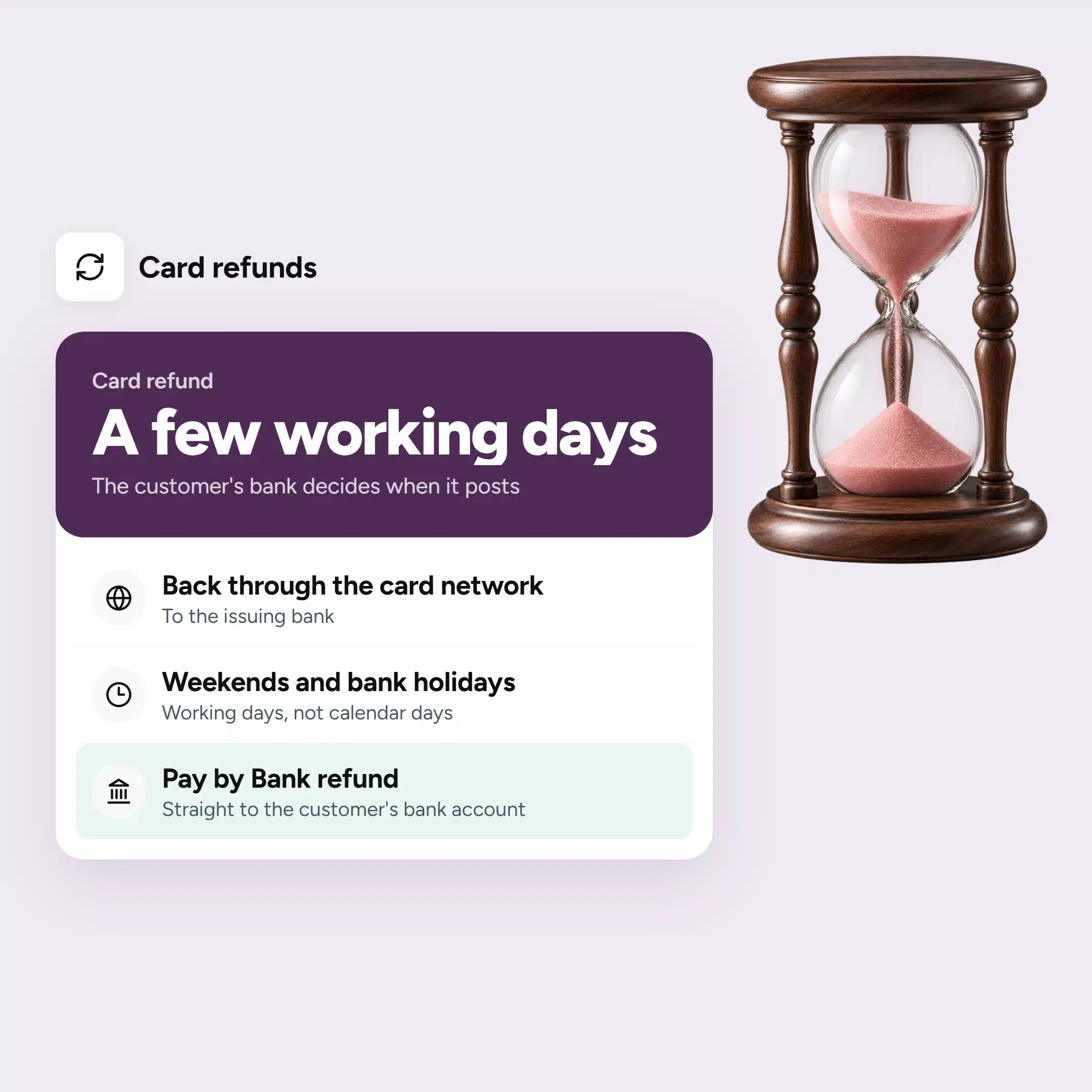
Most card refunds reach the customer within a week of being processed or take 3–10 business days to appear in customer accounts. Some arrive sooner, while others take longer depending on the payment provider, card issuer and transaction status.
Debit and credit card refunds have similar processing times, although the money appears differently in each account.
For businesses, the important distinction is between issuing a refund and the customer actually receiving it. Processing the refund through a card machine or payment dashboard doesn’t mean the money will arrive that day.
Card Refund Times in the UK
A card refund is a transaction where a merchant or payment network reverses a previous purchase and sends the money back through the financial system to your account. Here are the typical card refund times in the UK:
| Refund type | Practical timeframe | Where the money appears |
|---|---|---|
| Debit card refund | Allow 3–10 working days | Linked bank account |
| Credit card refund | Allow 3–10 working days | Credit card balance |
| Partial card refund | Allow 3–10 working days | Original card account |
| Cancelled pending payment | Depends on when the issuer releases the hold | Available balance increases |
These are indicative timescales rather than guaranteed deadlines. Actual processing times vary between payment providers and card issuers.
The countdown starts from the refund being processed, including only the working days. A refund processed late on Friday may not follow the same calendar-day timeline as one issued on Monday.
How Does a Card Refund Work?
A card refund is a separate transaction that credits money against an earlier card payment. It can return the full purchase amount or an agreed portion.
A card refund passes through four parties:
- The business sends the refund. Staff locate the original transaction and submit the refund through their card terminal, POS system or payment provider.
- The acquirer passes it to the card network. The business’s acquiring bank or payment processor sends the refund through Visa, Mastercard or the relevant card network.
- The card network routes it to the card issuer. The customer’s bank or credit card provider receives the incoming credit.
- The issuer posts the credit. It appears as a credit, an adjustment to the card balance or an updated transaction entry.
Once the refund reaches the card issuer, the business cannot guarantee when it will appear in the customer’s account. A merchant can confirm when the refund was processed, while the issuer determines when the credit is posted.
A refund can be submitted successfully by the merchant without immediately appearing on the customer’s statement.
How Long Does a Credit Card Refund Take?
Credit card refunds in UK usually take 3–10 working-days to appear in your account, but they don’t necessarily arrive as withdrawable money in a current account.
Instead, the refund is credited to the card account and reduces the outstanding balance.
If the refund arrives after the monthly statement has been produced, it may appear on the next statement.
A refund also shouldn’t be assumed to replace a required minimum repayment. Customers should follow their card issuer’s payment instructions.
How Long Does a Debit Card Refund Take?
A debit card refund typically takes 3–10 business days to appear in your account after the merchant releases it. Once completed, the money is credited to the bank account linked to the card used for payment.
For example, suppose a customer returns a £150 item on Tuesday and the business processes the refund that afternoon.
The customer may see the money within the same working week. However, the business should not promise a specific arrival date unless its payment provider confirms one.
If the customer has received a replacement debit card, the refund can usually still reach the underlying account. A closed bank account may need additional investigation.
What Delays a Card Refund?
There may be multiple things affecting the time between submitting a refund and receiving it, such as:
Bank and Payment Provider Processing
The merchant’s payment provider, card network and card issuer all have roles in completing the refund.
A transaction may also be delayed or declined. An unsuccessful refund needs investigation rather than simply more waiting. The customers may raise the issue if the card refund is taking more time than usual period.
Weekends and Bank Holidays
A timeline expressed in working days excludes weekends and applicable bank holidays.
A refund initiated just before a long weekend can therefore take longer in calendar days than expected.
International Card Payments
Cross-border refunds may involve additional processing, currency conversion or overseas card issuers.
The original transaction currency and any exchange-rate changes can also affect the amount shown on the customer’s statement.
Replaced or Closed Cards
Replacing an expired or lost card doesn’t automatically prevent a refund. However, if the underlying account has closed, the customer may need to contact their card issuer to recover the credit.
Refund vs Reversal: What’s the Difference And Why It Matters
A cancelled card payment and a refund are not same always. When a customer makes a purchase, the issuer may initially reserve the amount before the merchant collects it. This is an authorisation hold.
If the transaction is cancelled before capture, the merchant may be able to void the authorisation instead of issuing a refund.
For example, a car rental company might reserve a £300 deposit. If no charge is collected, the hold can be released without a separate £300 refund appearing.
The issuer controls when the reserved balance becomes available again while in completed payments, a refund generally creates a separate credit transaction. Businesses should check the original payment status before deciding which action is appropriate.
How Long Does a Business Have to Issue a Refund in the UK?
UK consumer law sets reimbursement obligations that are separate from card-processing estimates.
Online Purchases and Distance Selling
Under the Consumer Contracts Regulations 2013, eligible online and distance purchases carry cancellation and refund rights.
Whenever a customer cancels and returns goods, the business generally must reimburse them without undue delay and within 14 days of receiving the goods back or receiving evidence of their return, whichever happens first.
The refund must generally use the original payment method used by the customer unless the customer expressly agrees otherwise. Standard delivery charges must also be reimbursed where required.
Faulty Goods
As per Section 20 of the Consumer Rights Act 2015, a qualifying refund following rejection of goods must be provided without undue delay and within 14 days beginning with the day the business agrees the customer is entitled to it.
These rules do not allow an automatic right to return every unwanted item. Their rights depend on the type of purchase, the reason for the return and whether any legal exceptions apply.
The 3–10 working-day estimate covers card refund processing times, while UK consumer law sets separate deadlines for businesses to issue refunds.
What Should Businesses Do When a Refund Is Delayed?
A customer reporting a missing refund needs confirmation of what actually happened, not another broad estimate.
Start with the original transaction. Check that the refund was submitted for the correct amount and to the original card, and confirm whether the provider reports it as completed, pending or failed.
If the refund was completed but hasn’t appeared after the expected timeframe, request a tracing reference from the payment provider. For card refunds this is usually the Acquirer Reference Number (ARN), which the customer’s bank can use to find the credit. The customer can then contact their card issuer with the relevant information.
Retaining the refund date, amount, transaction ID and confirmation makes these enquiries easier to resolve.
NatWest and Barclaycard both ask customers for a refund receipt showing at least the card’s last four digits, the date and the amount, so send one with every refund.
If the refund was never successfully processed, the business needs to address that directly.
Unresolved refunds can also lead to card disputes. Keeping accurate records and handling customer complaints promptly are part of preventing avoidable chargebacks.
Are Pay by Bank Refunds Faster Than Card Refunds?
Pay by Bank refunds follow a different route because the it doesn’t use a debit or credit card network.
When a customer requests a refund, the merchant arranges a new payment back to the customer’s bank account.
Because no card is involved, there’s no card-scheme chargeback on it, so the refund comes from the business when the customer asks for it.
If that repayment uses Faster Payments, Pay.UK says the money is usually available almost immediately, though some payments can take up to two hours. However, the overall refund time also depends on when the merchant approves and sends the money, whether the payment succeeds and how its provider handles refunds.
Atoa, for example, allows businesses to initiate full or partial Pay by Bank refunds through its dashboard or Business app.
With Atoa Instant Settlement, the refund process can require the customer’s account number and sort code. With Atoa Payouts, businesses can select the original transaction and initiate the refund, subject to the available balance and processing status.
Final Thoughts
For card refunds in the UK, it takes 3–10 working days to complete a refund. The business can control when it initiates the refund, whether the amount is correct and how accurately it records the transaction. The payment provider and card issuer handle the remaining processing stages.
Keeping those responsibilities clear makes delayed refunds easier to investigate and gives customers a more accurate explanation of when to expect their money.
If you take both card and Pay by Bank payments, Atoa lets you issue refunds from one dashboard. Book a demo to see how it works across your sites.
FAQ
Why is my card refund showing as pending?
The customer’s bank knows the refund is on its way but hasn’t reached it yet. It usually completes within the bank’s normal timescale. If it’s declined instead, the business needs to process it again or agree another way to repay.
Can a refund go to a different card or by bank transfer?
UK consumer law expects refunds to go back by the original payment method unless the customer expressly agrees otherwise. If the original card account is closed and the refund is declined, merchant have to communicate with customer for an alternative method.
Can a customer raise a chargeback if a refund never arrives?
Yes. The customer can ask their card issuer to dispute the payment. On a credit card, Section 75 of the Consumer Credit Act 1974 may also apply where a single item costs more than £100 and no more than £30,000. It doesn’t cover debit cards.
Can a Pay by Bank payment be charged back?
No. Pay by Bank doesn’t use the card networks, so card chargebacks don’t apply.
SHARE ARTICLE
Share link copied!