
Ready to get started?
Easily integrate next-generation payments and financial data into any app. Build powerful products your customers love.
SHARE ARTICLE


 Share link copied!
Getting b2b payments is rarely as straightforward as taking a payment from a customer at checkout. B2B payments often involve purchase orders, invoice approvals, agreed credit terms and scheduled payment runs. Even after a payment is made, suppliers may still need to identify which invoice it covers, account for processing fees or follow up on a missing balance.
Going forward, B2B payments make up a large share of UK payment activity. According to UK Finance’s Payment Markets 2026 report, UK businesses made 5 billion payments to other businesses in 2025. While bank transfers remain widely used, b2b payment methods such as Pay by Bank, cards and Direct Debit give businesses different ways to collect payments. Each comes with its own costs, settlement times, transaction limits and dispute procedures.
Choosing between these B2B payment methods can affect cash flow, payment collection and the time spent reconciling accounts. This guide compares bank transfers, Pay by Bank, cards, Direct Debit and Bacs, covering their costs, speed, limits, chargeback exposure and suitability for different business payment requirements.
What Are B2B Payments?
B2B payments (business-to-business payments) are transactions in which one business pays another for buying goods or services from them. They cover supplier purchases, professional services, ongoing contracts and other commercial transactions.
Unlike business-to-consumer (B2C) payments, which are commonly initiated at checkout, B2B payments often follow an invoicing process. A supplier issues an invoice, the buyer approves it and payment is made according to the agreed terms, which may be immediate or within a time-period of 30, 60 or 90 days.
The invoice and payment serve different purposes in b2b payments. An invoice records the amount owed and when it is due, while the payment method determines how the money is transferred. Once the funds arrive, the receiving business must reconcile the payment against the outstanding invoice.
In the UK, commonly used B2B payment methods include Faster Payments, CHAPS, Pay by Bank, credit and debit cards, Direct Debit and Bacs Direct Credit. Each differs in who initiates the payment, how quickly it settles, what it costs and how payment disputes are handled.
B2B Payment Methods Comparison
Have a look the b2b payment methods comparison, costs, settlement times, transaction limits, chargeback exposure and reconciliation requirements.
| Payment method | Typical cost | Speed | Transaction limit | Chargeback risk | Reconciliation |
|---|---|---|---|---|---|
| Faster Payments | Low bank fees | Usually seconds | Up to £1m | No card chargebacks | Payment reference |
| CHAPS | Fixed bank fee | Same working day | No scheme cap | No card chargebacks | Payment reference |
| Pay by Bank | Provider fee | Usually seconds* | Bank/provider limits | No card chargebacks | Invoice-linked |
| Cards | Percentage-based fee | 1–3 working days* | Card/provider limits | Card chargebacks | Transaction reports |
| Direct Debit | Per-collection fee | 3 working days | Bank/provider limits | Guarantee refunds | Collection references |
| Bacs Direct Credit | Low batch fees | 3 working days | Up to £20m | No card chargebacks | Remittance details |
Costs and processing times vary by bank, payment provider and account arrangement.
Top B2B Payment Methods in the UK
Here is a closer look at the most widely used B2B payment methods:
Bank Transfers: Faster Payments and CHAPS
Bank transfers allow customers to send money directly from their business bank accounts. In the UK, the two main options for immediate or urgent transfers are Faster Payments and CHAPS.
Faster Payments operates around the clock and usually completes transfers within seconds. Pay.UK confirms a maximum of £1 million per payment at scheme level, although banks can impose lower transaction and daily limits.
The cost of receiving a domestic bank transfer is usually low. However, the receiving business has little control over when the customer initiates it.
Reconciliation is another consideration. If a customer omits the invoice number, uses an incorrect reference or combines several invoices into one transfer, the finance team must identify what the payment covers.
CHAPS is designed for high-value and time-sensitive transfers. The Bank of England confirms that CHAPS has no minimum or maximum scheme-level payment limit.
It operates on working days, with a system deadline of 5.40pm for customer payments. Individual banks may require instructions earlier.
CHAPS settlements are irrevocable between participating banks. This provides settlement certainty but does not remove every possibility of a fraud investigation or recovery claim.
For businesses handling large, urgent invoices, CHAPS may be suitable when Faster Payments limits prevent the required amount from being sent.
Pay by Bank: Faster Payments Without Manual Bank Details
Pay by Bank uses open banking technology to initiate a payment from the customer’s bank account. The business sends a payment request through a link, QR code or online checkout. The customer selects their bank and approves the transaction within their banking app.
The payment typically moves over Faster Payments, but the customer doesn’t need to enter the recipient’s sort code, account number or payment amount manually.
This is the main difference between an ordinary bank transfer and an open banking payment. Both can move money directly between bank accounts, but Pay by Bank adds a structured payment request.
For businesses collecting invoice payments, the benefit is particularly relevant to reconciliation. Linking a payment request to an invoice allows the provider to associate the payment with the correct amount and reference. Where accounting integration is supported, the invoice status can update automatically.
Pay by Bank also avoids card-scheme chargebacks. However, customers can still request refunds or raise fraud and payment-error claims through the relevant processes.
Pay by Bank Transaction Limits
Pay by Bank restrictions depend on the payment provider and the customer’s bank.
Atoa’s published standard limit is £15,000 per transaction. Businesses with higher-value payment requirements can request an increase to £25,000, subject to approval and the customer’s bank supporting the amount.
The provider’s limit and the payer’s bank limit are separate. A higher limit approved by a payment provider does not guarantee that every customer can authorise the full amount.
Businesses regularly issuing invoices above these limits should check the available options before selecting Pay by Bank as their main collection method.
Card Payments: Convenient but More Expensive for Some Business Transactions
Credit cards, debit cards and commercial cards allow customers to settle invoices through payment links, online checkouts or payment terminals.
Card payments can be useful when customers prefer their existing purchasing processes or need access to credit provided by their card issuer.
For the receiving business, processing fees are a major consideration. Card acceptance charges typically include interchange, scheme fees and the acquiring provider’s margin. Charges depend on the card type, provider agreement and whether the payment is domestic or international.
The Payment Systems Regulator confirms that qualifying domestic consumer card interchange fees are capped at:
- 0.2% for consumer debit cards.
- 0.3% for consumer credit cards.
These caps apply to interchange fees, not the total merchant processing charge. Commercial cards are generally outside these consumer-card caps, which can make business card acceptance more expensive.
Card authorisation and settlement also happen at different times. A payment may be authorised immediately, while clearing, settlement and the provider’s payout schedule determine when the business receives its money.
Card chargebacks create a separate risk. A cardholder may dispute a transaction through their issuer under the applicable scheme rules, requiring the merchant to provide supporting evidence.
Cards remain useful for B2B payments, although businesses receiving large invoices should consider their commercial-card processing rates and settlement arrangements.
Direct Debit: Collecting Recurring B2B Payments
Direct Debit allows a business to collect money from a customer’s bank account after obtaining a valid mandate.
Unlike a bank transfer, the receiving business initiates collection rather than waiting for the customer to send the money.
This makes Direct Debit suitable for ongoing service contracts, subscriptions and other regular billing arrangements.
Collections can be fixed or variable, subject to the mandate and applicable notification requirements.
The Bacs Direct Debit scheme uses a three-working-day processing cycle. The business must also allow for mandate setup and advance notice.
Under the Direct Debit Guarantee, customers are normally notified of changes to the amount, date or frequency ten working days in advance, unless another period has been agreed.
If a Direct Debit is collected in error, the payer is entitled to a full and immediate refund from their bank. The collecting business may subsequently face an indemnity claim.
Direct Debit works best when recurring collections are predictable and customer records are maintained accurately. For occasional invoices requiring immediate payment, its setup and processing requirements can be less practical.
Bacs Direct Credit: Scheduled and Bulk Business Payments
Bacs Direct Credit is widely used for payroll, supplier payments and other scheduled transfers.
Unlike Direct Debit, where the receiving business initiates collection, Bacs Direct Credit is controlled by the payer.
Payments are usually submitted in batches and processed across three working days:
- Input day: Payment instructions are submitted.
- Processing day: Banks receive and process the instructions.
- Entry day: The payer’s account is debited and the recipient’s account is credited.
According to UK Finance’s 2026 report, Bacs Direct Credit accounted for 1.8 billion payments in 2025. It represented 23% of payments made by businesses, down from 56% in 2015.
The decline reflects the growing use of Faster Payments, but Bacs remains important for organisations processing large volumes of scheduled transfers. Its main advantage is predictable, low-cost batch processing.
The limitation is flexibility. Payments must be prepared before the relevant submission deadline, and weekends or bank holidays affect the processing schedule.
For suppliers receiving Bacs payments, reliable reconciliation depends on customers providing accurate payment references and remittance information. A single incoming credit may relate to several invoices, requiring the receiving business to allocate the payment correctly.
Chargebacks and Payment Reversals Are Not the Same
Payment reversals are often treated as a single risk, but the rules differ considerably between methods.
Card payments are subject to chargebacks under card-scheme rules. Direct Debit has a separate guarantee protecting customers against collection errors.
Faster Payments, CHAPS and Pay by Bank do not use the card chargeback process. Nevertheless, customers can still report fraud, request recovery of mistaken transfers or pursue contractual disputes.
The UK’s authorised push payment (APP) scam reimbursement requirements also provide protection to eligible individuals, microenterprises and charities using Faster Payments and certain CHAPS payments. The standard maximum reimbursement is £85,000 per claim, subject to the scheme’s conditions.
Larger businesses are generally outside those mandatory reimbursement protections.
For B2B transactions, the absence of card chargebacks should therefore not be confused with an absolute guarantee against payment disputes or fraud-related recovery processes.
Reconciliation: The Cost Beyond Transaction Fees
Processing fees are straightforward to compare. Reconciliation takes more investigation.
A payment that arrives without a usable reference still needs to be identified, allocated to the correct invoice and recorded in the accounts.
The amount of manual work differs between payment methods.
With manual bank transfers, accuracy depends partly on the customer’s reference. Pay by Bank can associate a transaction with an invoice at initiation, provided the payment provider supports that function.
Card payments may be settled through grouped payouts after processing fees have been deducted. Finance teams then need transaction-level reports to match those payouts to individual invoices.
Direct Debit collections can be associated with customer records, although failed payments and indemnity claims must also be recorded. Bacs Direct Credit relies on accurate references and remittance information.
When comparing methods, businesses should check whether their accounting software can:
- Match individual payments against outstanding invoices.
- Record partial payments and outstanding balances.
- Identify failed, refunded or disputed transactions.
- Separate processing fees from the original invoice amount.
- Reconcile grouped payouts against individual transactions.
These capabilities depend on the software and payment provider, rather than the underlying payment scheme alone.
How to Choose the Right B2B Payment Method?
The most suitable method depends on three practical considerations: transaction value, payment frequency and who needs to control collection.
- For one-off invoices, Faster Payments is straightforward when customers can initiate and reference payments correctly. Pay by Bank can reduce manual entry and improve matching where supported by the provider.
- For larger transactions, check the actual limits imposed by the payer’s bank and payment provider. CHAPS remains an option for high-value transfers requiring same-day settlement.
- For recurring invoices, Direct Debit allows the receiving business to initiate collections under an existing mandate. Bacs Direct Credit is better suited to payer-controlled payment runs and scheduled supplier settlements.
- For customers who prefer card payments, accepting commercial cards can provide flexibility, although processing charges and chargeback exposure should be considered.
Businesses should compare the full cost of accepting a payment, including fees, settlement delays, reconciliation work and dispute handling.
The payment method is only one part of this decision. Accounting integrations, approval workflows and reporting are separate considerations when comparing B2B payment solutions.
A practical payment setup may involve bank-based collection for most invoices, Direct Debit for recurring arrangements and cards where customers need them. The priority is to make sure each method works with the business’s invoice values, collection process and accounting records.
Which B2B Payment Options to Offer
Most finance teams offer more than one method and steer customers by invoice size, urgency and how often they bill.
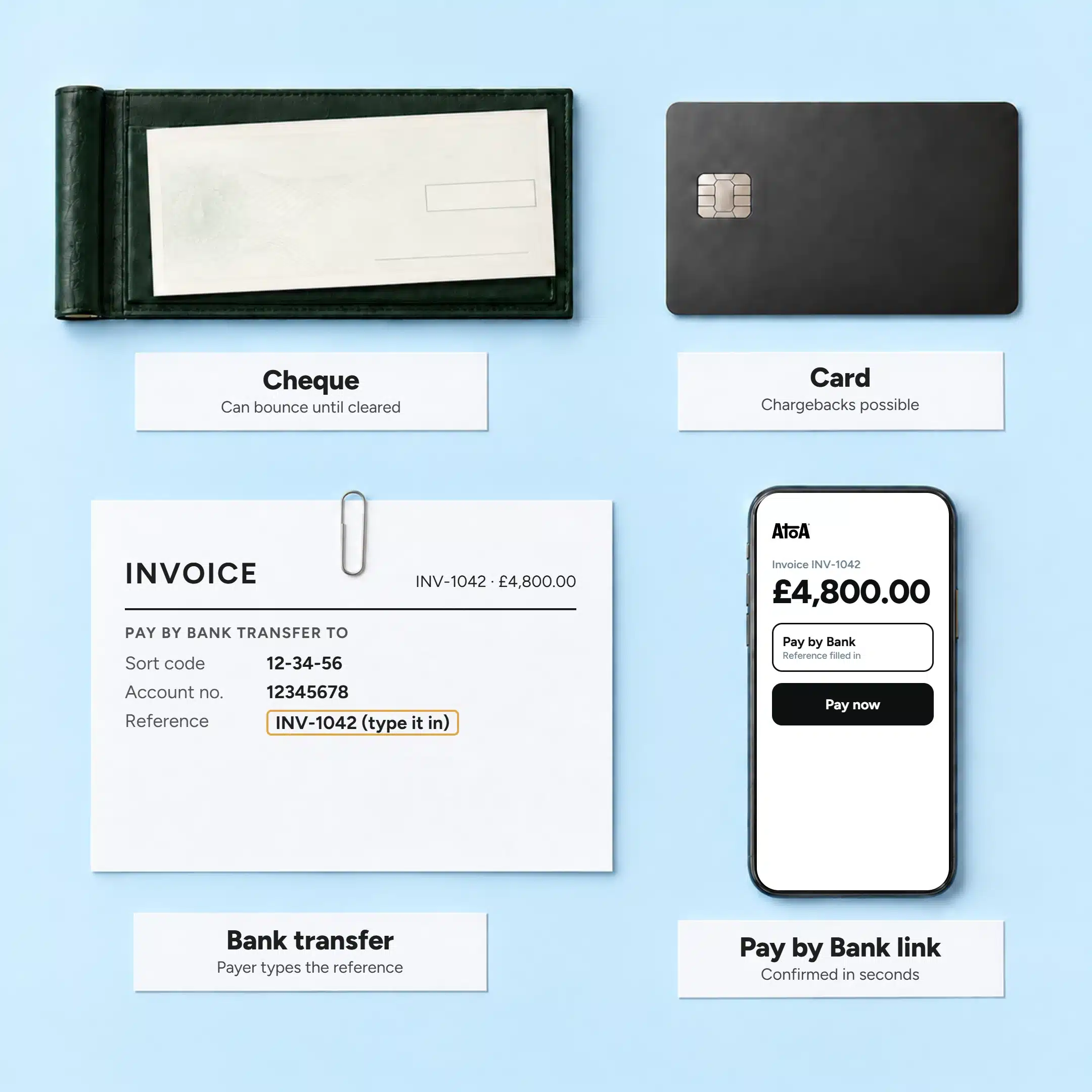
- Routine invoices up to £15,000: a pay-now link with Pay by Bank and card lets the customer choose, with Pay by Bank at lower fees and no chargebacks, and card for buyers who have to pay on a company card.
- Invoices above £15,000: ask Atoa for a higher limit, or give bank details for Faster Payments within the payer’s limit, or CHAPS when the money must arrive the same day.
- Recurring fixed amounts: Direct Debit, through a provider that offers it.
- Payment runs from large customers: expect Bacs Direct Credit on the payer’s own cycle, and ask for a remittance advice with each run.
- Cheques: accept them from payers who insist, and allow for the extra handling.
Whichever mix you choose, put every accepted method and the details it needs on the invoice itself, so the payer does not have to ask. For a wider look at platforms and software for business payments, see our guide to B2B payment solutions.
FAQs
What are the main B2B payment methods in the UK?
The main b2b payment methods used in UK are bank transfers over Faster Payments, CHAPS and Bacs, Direct Debit, card and Pay by Bank, with cheques still used by some payers. Many invoices are settled by bank transfer; Direct Debit suits recurring billing, card suits buyers on company cards, and Pay by Bank lets a customer pay an invoice from a link in their Bank app.
How do businesses pay each other?
Usually by bank transfer against an invoice: the payer sends a Faster Payment, a Bacs Direct Credit in a supplier payment run, or a CHAPS payment for large or urgent sums, quoting the invoice number. Where the supplier offers them, businesses also pay by card, by Direct Debit for recurring bills, or by Pay by Bank through a payment link on the invoice.
What is the Faster Payments limit?
The scheme limit is £1 million per payment, but banks set their own limits by channel and account type, often lower, and some also limit how much can be sent in a day. One high-street bank’s business online banking, for example, allows £100,000 per payment and £250,000 a day. Check your bank’s limit before a large payment is due.
When should a business use CHAPS?
Use CHAPS for large or time-critical payments that must arrive the same working day, or for amounts above your Faster Payments limit. CHAPS has no scheme minimum or maximum, though bank channel limits can apply, and customer payments must be submitted by 5.40pm or your bank’s earlier cut-off. Your bank charges a fee for each CHAPS payment.
How long does a Bacs payment take?
A Bacs payment takes three working days from submission. The file is submitted on day one, processed on day two, and the money reaches the payee’s account on day three. Payments can be set up to 30 days in advance, and a payment can be recalled only if the payer’s bank is told before its cut-off.
Can B2B card payments be charged back?
Yes. Card payments, business ones included, can be charged back under the card schemes’ rules, which set the grounds and time limits for a dispute. Pay by Bank payments have no chargebacks, because the payer authenticates each payment in their own Bank app, but customers can still ask for a refund under the business’s own refund policy.
Sources:
SHARE ARTICLE
Share link copied!