
Ready to get started?
Easily integrate next-generation payments and financial data into any app. Build powerful products your customers love.
SHARE ARTICLE


 Share link copied!
Completing a mortgage case doesn’t mean you will receive the money instantly. Mortgage and protection adviser fees don’t all come from the client. A mortgage lender pays a procuration fee for arranging a mortgage, an insurer pays protection commission, and the client may pay a separate advice fee. These payments arrive at different stages, and some protection commission can be reclaimed if a policy ends early.
This is why financial adviser ongoing fees in the UK can be a misleading comparison. Investment advisers often charge a percentage of a client’s portfolio, while mortgage and protection firms typically deal with one-off client fees, commissions and mortgage adviser network fees.
This guide explains the difference between initial and ongoing mortgage and protection advice fees, when clients are charged, how protection commission and network fee splits affect income, and how firms can collect and track client payments.
What Are Financial Adviser Ongoing Fees in the UK?
The average ongoing financial adviser fee in the UK is 0.83% a year in 2026, up from 0.77% in 2025, according to NextWealth’s Fee Benchmarking Report.
This figure mainly relates to investment advice, where a firm manages or advises on a client’s investments and charges an annual percentage of their value.
Independent financial adviser fees for investment advice commonly fall between 0.5% and 1% a year. Initial advice, such as setting up an investment portfolio or financial plan, may be charged separately.
Mortgage and protection advice works differently. A mortgage is a loan rather than an investment portfolio. Similarly, a protection policy provides insurance cover rather than a fund from which an adviser normally deducts an annual fee.
Mortgage and protection advisers can charge for ongoing services, but the 0.83% investment advice benchmark is not a standard fee for their work.
The distinction matters when comparing what firms charge. A financial adviser managing investments and a mortgage adviser arranging a home loan may both provide financial advice, but they are paid under different arrangements.
How Mortgage and Protection Advisers Get Paid
A firm offering mortgage and protection advice can earn income from several sources. Some payments come directly from clients, while others come from lenders or insurance companies.
| Income type | Who pays? | When is it usually paid? |
|---|---|---|
| Mortgage client fee | Client | At application, mortgage offer or completion, depending on the agreement |
| Procuration fee | Mortgage lender | Usually after the mortgage completes, under the lender’s terms |
| Protection commission | Insurer | Upfront or over time, depending on the commission arrangement |
| Ongoing service fee | Client | As agreed for a continuing service |
A procuration fee is the commission a lender pays an adviser or intermediary for arranging a mortgage. The client does not pay this commission directly to the adviser, although the adviser may also charge a separate client fee.
Protection commission is paid by the insurer for arranging insurance cover, such as life insurance, critical illness cover or income protection.
A firm may also charge clients directly for mortgage advice, protection advice or agreed additional services.
This differs from retail investment advice, where the FCA’s adviser-charging rules generally prohibit advisers from receiving product commission for new investment advice business.
Mortgage and pure protection advice have separate remuneration and disclosure rules, so commission remains part of how many firms earn their income.
Initial and Ongoing Advice Fees: What Can Firms Charge?
Mortgage and protection advisers may charge one-off fees, ongoing fees or both, depending on the services provided. Here’s how each fee works and what it covers.
Initial Advice Fees
An initial fee covers the advice or work agreed at the start of a client relationship.
For mortgage firms, this may include assessing the client’s circumstances, researching suitable mortgage products, preparing an application and helping the client through the lending process.
Some firms charge one fixed amount while others split the fee between stages of the application. The amount and timing depend on the firm’s terms.
The FCA requires mortgage firms to explain their fees before the client becomes liable for them, including when payment is due and whether it may be refunded.
Protection advisers charging clients directly must also explain their fees. Under ICOBS 4.3, the fee amount, or how it is calculated, must be disclosed before the client becomes liable or the insurance contract is concluded, whichever comes first.
Ongoing Advice Fees
An ongoing fee pays for a continuing service rather than a single piece of advice.
A firm may agree to provide regular reviews or support under a continuing service arrangement. Other firms charge a fresh one-off fee when a client needs new advice, such as arranging a remortgage.
For advisers who also provide investment or pension advice, the FCA has specific rules about ongoing charges, the services they cover and clients’ cancellation rights.
The FCA examined this area in February 2025. In its review of 22 large investment advice firms, promised suitability reviews had been delivered in around 83% of cases. In another 15%, clients had declined or not responded. Firms had made no attempt in fewer than 2% of cases.
The review did not cover mortgage and protection advice, so those figures should not be treated as findings about mortgage firms.
Still, the underlying issue is relevant to any business charging for continued support: clients should know what they are paying for, and firms should be able to show that the agreed service was provided.
When Should Mortgage Advisers Collect Client Fees?
Mortgage firms may collect their fees at different stages, depending on their agreed terms. Here are the three common stages when client fees are collected:
- During application: The firm receives payment earlier, often after completing the initial advice and application work. If the case doesn’t proceed, the client may ask for a refund, depending on the agreed terms.
- At mortgage offer: Payment becomes due once the lender has issued an offer. The client has reached a significant stage in the process, although the mortgage hasn’t completed yet.
- During completion: The client pays when the mortgage completes. This delays income for the firm and means work on unsuccessful cases may go unpaid unless the agreement provides otherwise.
Some firms split their fee, collecting part at application and the remainder at offer.
The payment stage should be clear from the beginning to avoid conflicts. Clients are more likely to question a charge that arrives unexpectedly, even when the work behind it has already been done.
Under MCOB 4.4A.8R, firms must disclose their fees, when they become payable and, where applicable, when they are reimbursable. They must also explain whether they receive lender commission and whether it reduces the client’s fee.
For a closer look at typical charges and refund arrangements, the separate guide to mortgage broker fees in the UK covers the client’s side of these payments.
Protection Adviser Commission: Indemnity, Non-Indemnity and Clawback
Protection commission is different from an ordinary client fee because the insurer pays it, and some of that money may have to be returned later.
There are two main payment arrangements.
Indemnity Commission
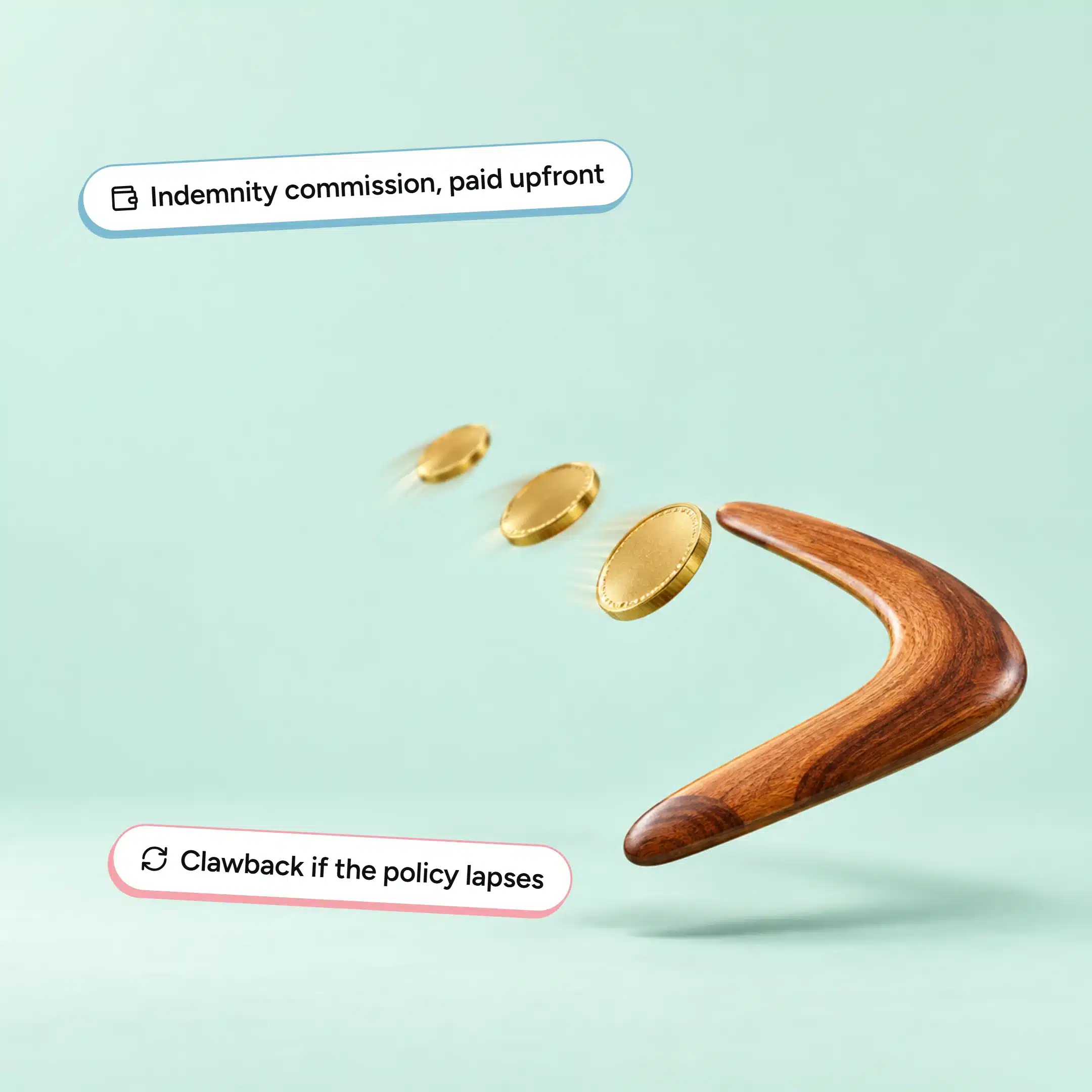
With indemnity commission, the insurer pays an agreed amount upfront when the policy starts.
This gives the advisory firm income early in the policy’s life. However, it also carries a repayment risk.
If the client cancels the policy or stops paying premiums during the agreed period, the insurer may reclaim part or all of the commission.
This is known as commission clawback.
The FCA’s 2026 pure protection market study found that clawback periods are commonly set at two or four years, depending on the arrangements between insurers and intermediaries.
For a firm receiving a substantial amount of upfront protection commission, that money isn’t necessarily free of future obligations. Some of it may still be at risk until the clawback period ends.
Non-Indemnity Commission
Non-indemnity commission is paid gradually as the policy continues.
The firm receives money over time instead of taking most of the expected commission upfront. If the policy ends, future commission generally stops, subject to the insurer’s terms.
Some insurers also offer arrangements combining upfront and later payments.
Neither approach is automatically better for every business. Indemnity commission provides earlier income but creates a possible repayment obligation. Non-indemnity commission provides more gradual income.
Advisory firms need to understand which arrangement applies to each policy, especially when forecasting revenue or assessing how much commission could be clawed back.
The FCA’s September 2026 pure protection market study also examined how commission arrangements can influence advice and policy switching. Firms remain responsible for making suitable recommendations and meeting the applicable rules, regardless of how they receive commission.
Mortgage Adviser Network Fees and Appointed Representative Income Splits
Many mortgage and protection advisers operate as appointed representatives (ARs) of a larger network.
An appointed representative carries out regulated activities under the responsibility of an FCA-authorised firm, known as the principal. The principal is responsible for overseeing those activities.
In return for the network’s services, appointed representative firms may pay monthly charges, share some of their commission or fees, or both.
The exact arrangement depends on the network agreement.
A firm might retain one percentage of mortgage procuration fees and a different percentage of protection commission. Client fees may also have separate arrangements.
When comparing mortgage adviser network fees, the headline commission split tells only part of the story.
A network offering a larger share of commission may charge separately for software, compliance support or membership. Another may retain a greater share but include more services.
Clawback arrangements matter too. If an insurer reclaims protection commission, the AR agreement should explain how that repayment is handled between the network and adviser.
Who Collects the Client Fee?
Some appointed representatives collect client fees directly into their own business accounts. Others work through networks that collect fees centrally and distribute the appropriate share afterwards.
The difference affects invoicing, accounting and payment records.
Where the AR collects directly, it needs to record the client’s payment and account for any amount owed to the network.
Where the network collects centrally, the payment must be matched to the correct adviser and client case.
Before introducing a new payment method, firms should check what their appointed representative agreement allows. A payment service processes the fee, but it doesn’t replace the financial arrangements between the network and its members.
How to Collect Mortgage and Protection Client Fees
Lender and insurer commissions are paid through established arrangements. Direct client fees need more attention from the advisory firm.
Bank transfers are familiar and can be inexpensive. The difficulty comes when a client forgets the reference, pays the wrong amount or sends the money without identifying the case.
Someone then has to find the payment and match it to the right client.
Card payments are convenient, but processing charges apply, and clients can raise chargebacks when they dispute a transaction.
Payment links offer another way to collect fees remotely. The firm sends a request showing the amount due, and the client opens it to make the payment.
For mortgage and protection firms, the payment request can be sent when the agreed fee becomes payable. This avoids asking clients to enter bank details manually or arrange a separate transfer.
Collecting Client Fees Through Pay by Bank
With Pay by Bank, clients open a payment link, choose their bank and approve the payment through their banking app.
Unlike a manual bank transfer, the payment request is already connected to the amount the business expects.
Pay by Bank payments are usually confirmed within seconds and aren’t subject to the card-scheme chargeback process. Refund obligations and applicable fraud or dispute procedures still apply.
Payment costs also matter when a firm collects fees regularly.
For firms collecting client fees across multiple advisers, payment tracking can be as important as the transaction cost.
Atoa lets businesses send payment links by SMS or email, accept Pay by Bank or card payments and review transactions in one dashboard. Firms can also collect invoice payments using a pay-now link.
Where connected, accounting integrations such as Xero help match payments to invoices without entering the same information twice.
These services collect the client’s fee. They do not administer lender commission, insurer commission clawbacks or payments split between a network and its appointed representatives.
Collecting Fees for Ongoing Services
Where a firm charges for an agreed ongoing service, it must also decide how each payment will be requested.
A one-off Pay by Bank link can be sent when a fee falls due. The client approves that payment in their banking app.
Card on File is another option where supported and agreed with the client. It allows a business to retain a securely stored card credential for later authorised charges.
This should not be confused with an automatic recurring Pay by Bank arrangement or Direct Debit. Atoa’s recurring Pay by Bank feature is listed as coming soon, and Atoa does not currently offer customer-facing Direct Debit collection.
Whichever method a firm uses, the fee must remain consistent with the client’s agreement, the services provided and the applicable FCA requirements.
Keeping Adviser Fees and Commission Records Clear
For mortgage and protection firms, income can arrive from different directions and at different times. A completed case might have a lender payment still outstanding, an insurer commission advance and a client advice fee that hasn’t yet been settled.
Keeping those payments separate makes it easier to understand how much a case has earned and how much the business is still owed.
The same applies to refunds and clawbacks. A client fee refund is not the same as an insurer reclaiming commission, and the firm’s records need to show the difference.
Clear fee agreements, consistent case references and reliable payment records make that work easier. They also reduce the chance of awkward conversations with clients about money that was never clearly explained.
Sources
- FCA — Ongoing Financial Advice Services Review, February 2025
- FCA Handbook — COBS 6.1A: Adviser Charging and Remuneration
- FCA Handbook — ICOBS 4.3: Insurance Fee Disclosure
- FCA — CP26/10: Simplifying the Pensions and Investment Advice Rules
- FCA — Pure Protection Market Study, September 2026
- FCA — Responsibilities for Appointed Representatives
SHARE ARTICLE
Share link copied!